

When a Skill Isn't Enough, Build Your Agent an App
Why I built Tally, a local list app whose only user is my AI agent, and what changes when you design software for an agent instead of a person.
I wanted to get back into keeping a todo list. When I looked at the tools I already had, they all felt too heavy. Notion and Linear are great for real projects, but way too much for “buy milk.” And my grocery list lived in a separate app on my phone that I updated by hand.
Lately Claude has become my interface into all sorts of software. Instead of opening an app and clicking around myself, I just ask Claude. So what I wanted was dead simple: a list my agent could manage for me, so keeping it up wouldn’t take any work. Nothing that existed was quite that, so I built one. It’s called Tally, and it’s a todo app with no UI, because I’m not the one using it.
Skills vs. Apps
The usual way to give Claude a new ability is a skill: instructions that teach it how to do something with tools it already has. But a skill can only work with what’s already there. When the thing underneath is built for people, the skill turns into a list of workarounds. Sometimes your agent doesn’t need better instructions. It needs a better tool.
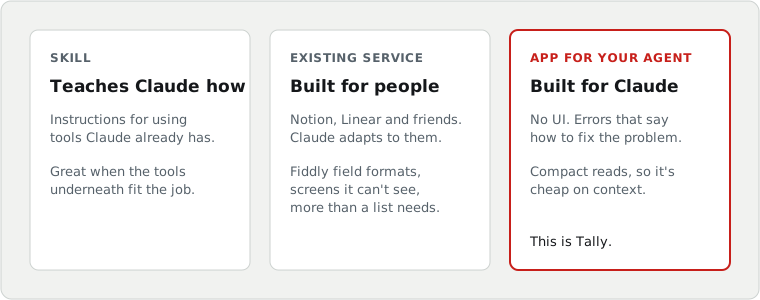
So that’s Tally: an MCP server, running locally on my Mac, whose only user is Claude.
Designing for an Agent
Once you decide the agent is the user, a lot of design decisions get easier, and some of them come out a little weird.
There’s no UI. The agent guide literally says “There is no UI; you are the user interface.” If I want to know what’s on my list, I ask Claude.
Errors are written for the agent. The most useful thing an error can do for an agent is tell it exactly how to fix the problem, so it can just try again:
Unknown tags 'bugg', 'urgnt'. Tags must be created before use: call create_tag first, or fix the spelling. Existing tags: 'bug', 'idea'.Having to create tags first would annoy a human. For an agent, it means a typo can’t quietly split one tag into two.
Lists carry instructions. Each list can hold instructions like “item titles must start with a verb,” so Claude picks up my preferences without me repeating them.
Context is the scarce resource. Reads are paginated and compact, and list instructions only come back on the first page. A human doesn’t care if a screen repeats itself. An agent pays for it in tokens.
Order is priority. There are no priority fields. The first item is the most important one, and Claude moves things up and down to change that.
Building It (While Watching a Movie)
The idea had been bouncing around in my head for a couple of days, so by the time I sat down on Saturday, I already knew what it should be.
I followed the same process I wrote about in Agentic Waterfall. I brainstormed a design doc with Claude in Notion, Claude broke it into 11 tickets in Linear, and I had Claude Code work through them while I watched a movie. All 11 commits landed in about 20 minutes. It was small enough that I skipped milestones and built it all at once to about 90%.
Testing It on the Agent
If your user is an agent, your usability tests should be on the agent too. Tally has a test script that hands a real Claude Code session a small workflow, then asks for a summary “and anything about the tools that confused you.”
Claude got everything right, and flagged three things. Two were real: reordering within a list used a different tool than moving between lists, and that tool called its position argument to instead of position. I fixed both. The third, completing an item that’s still blocked, is on purpose.
That’s the last 10% from agentic waterfall, except the user told me where the rough edges were.
Running It
If you want to try it, you’ll need Rust:
cargo install --git https://github.com/msiebert/Tally
claude mcp add tally --scope user -- tally
Or just point your agent at the Tally site. There’s an llms.txt there written so an agent can figure out Tally on its own.
Your Agent Needs Software Too
People have been talking for a while about how AI makes custom software cheap enough to build just for yourself. I think the more interesting version is building software for your agent. When a skill can’t get Claude where you want it, because the tools underneath were made for people, you can just make it a better tool. It took me an afternoon and a movie.
I’d love to hear what you’d build for your own agent, or if you’ve already built something like this. Let me know!
Comments
Let me know what you think!